
Conserving the Amphibian Jewels of Panama
Written and photographed by Nick Garnhart
As a field technician and scientific illustrator with Virginia Working Landscapes (VWL), a program of Smithsonian’s National Zoo and Conservation Biology Institute (NZCBI), I’ve always had a desire to contribute to conservation. I’ve collaborated with an amazing research and communications team in my current role. Whether out in the field conducting biodiversity research, studying natural life histories of local native species, or translating science into visuals with illustration, I’ve gained a greater appreciation for how teams work together, from research to outreach, to make conservation happen.
After meeting world-traveling scientists through other NZCBI departments, I have often wondered how I could apply my skills to aid their goals, as well as find ways to learn and incorporate their field methods into the research we conduct in Virginia.
For two weeks in January, I had an incredible opportunity to join team members from the NZCBI’s Center for Species Survival (CSS) at the Smithsonian Tropical Research Institute (STRI) in Gamboa, Panama. During my time there, I assisted with several projects and shadowed the talented biologists in the field, learning their conservation goals, research methods, and outreach tools.

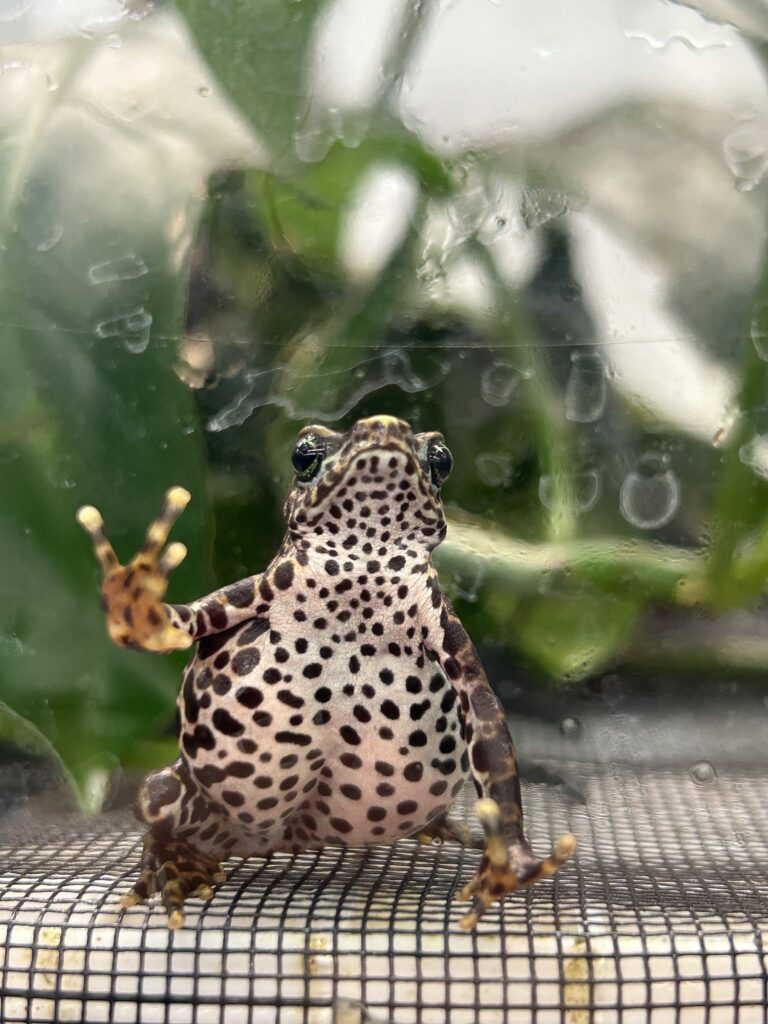
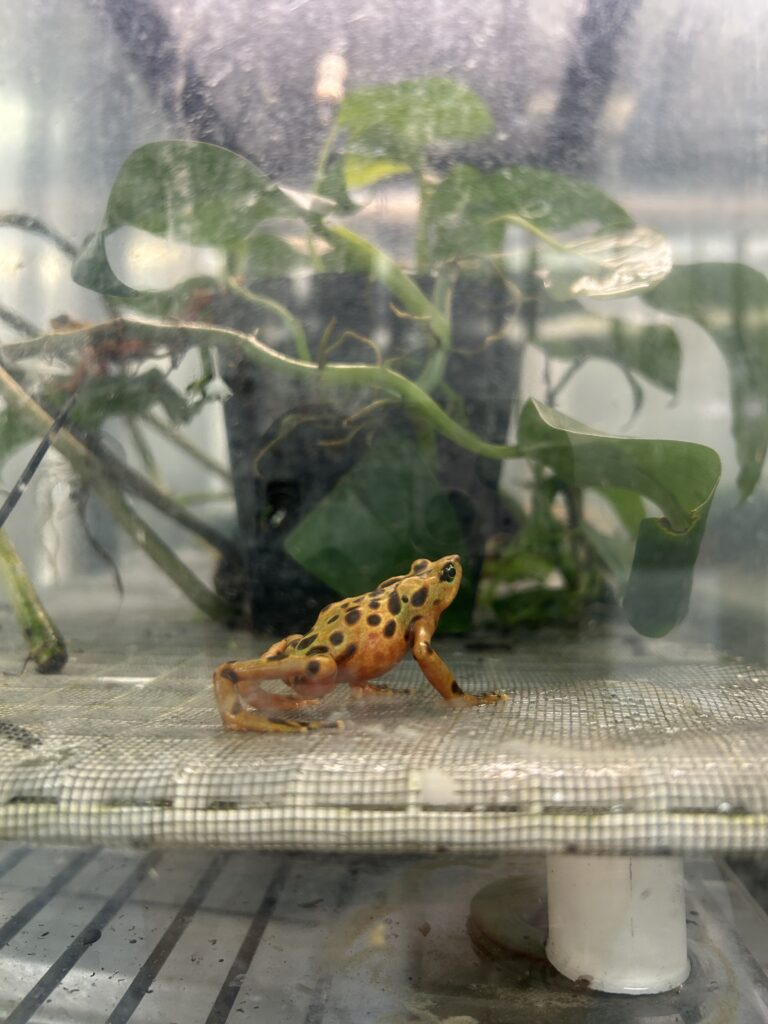
My Panamanian home base was STRI’s frog pods. These small buildings host sensitive breeding populations of critically endangered frogs, most of which are at risk due to chytrid—an invasive fungus that affects amphibians’ ability to regulate their temperature and absorb oxygen and water. These pods are critical, as they protect some of the last remaining individuals of these species from outside pathogens while helping researchers boost their populations for future reintroduction. Walking through the pods, I listened to the chirps and peeps that once filled Panama’s forests. Peering into the terrariums of endangered frogs, I was overcome with the enormous responsibility that these biologists have, and the hope that comes with each frog raised there.
Left photo: CSS biologist, Nate Weisenbeck, gently holds a Panama Rocket Frog (Colostethus panamansis) after swabbing it for chytrid fungus. Photo credit: Nick Garnhart
My Panamanian home base was STRI’s frog pods. These small buildings host sensitive breeding populations of critically endangered frogs, most of which are at risk due to chytrid—an invasive fungus that affects amphibians’ ability to regulate their temperature and absorb oxygen and water. These pods are critical, as they protect some of the last remaining individuals of these species from outside pathogens while helping researchers boost their populations for future reintroduction. Walking through the pods, I listened to the chirps and peeps that once filled Panama’s forests. Peering into the terrariums of endangered frogs, I was overcome with the enormous responsibility that these biologists have, and the hope that comes with each frog raised there.

My mentors and guides for this portion of the trip were staff from Panama Amphibian Rescue and Conservation Project (PARC) and Nate Weisenbeck, a CSS biologist who frequently commutes from Virginia to Panama for this project. During stream surveys looking for frogs, the team taught me about their reintroduction efforts of several endangered frog species, including Pratts Rocket Frog (Colostethus pratti). These efforts proved to be successful–I got to experience Weisenbeck’s excitement when he heard one of these tiny, released frogs singing somewhere in the underbrush.


PARC’s small team limits their ability to monitor released individuals and survey remote locations, so they use autonomous recording units (ARUs) to support their research. The ARUs record forest sounds for one out of every ten minutes, allowing researchers to gather large volumes of data on frogs across a broad area. Through their use, PARC’s team discovered the three frog species they had previously believed were extinct in the study area. I was struck by the value of this approach and was excited to bring it back to Virginia, where Dr. Brian Gratwicke, Weisenbeck, and I recently launched a pilot study on Virginia’s frog communities.
Right photo: A Harlequin Treefrog (Dendropsophus ebraccatus) enjoying the rain in Altos de Campana National Park. Photo Credit: Nick Garnhart

During my visit to STRI, I met many staff and interns, many of whom are from Central and South America and live in the small town of Gamboa. Residents and visitors alike have a deep relationship with the natural environment and engage with science through STRI’s outreach and the area’s rich biodiversity. STRI is also developing a public-facing frog pod exhibit that will allow locals and tourists to see these species up close, often for the first time.
As I returned home, I carried a sense of optimism about the role of conservation, both in Panama and in my own community. Front Royal VA, where my work is based, reminds me in many ways of Gamboa; both towns are surrounded by forests rich in biodiversity and their communities are closely connected to the natural world. In Panama, I saw how community, research, and emerging technologies come together in ways that closely mirror the goals I have for my own conservation efforts in Virginia. I’m excited to build on these goals through my work as a scientific illustrator. The connection between art and science is profound, helping people understand and connect with science and nature in ways that words alone often can’t.
I’m so grateful for the opportunity to experience this work firsthand with Dr. Gratwicke and his team and to bring those insights back with me as I continue supporting conservation efforts closer to home.

First photo: An uncommon Fringe-Limbed Tree Frog (Cochranella euknemos) surprised us all by appearing unseasonably on a palm frond next to the trail. Photo credit: Nick Garnhart